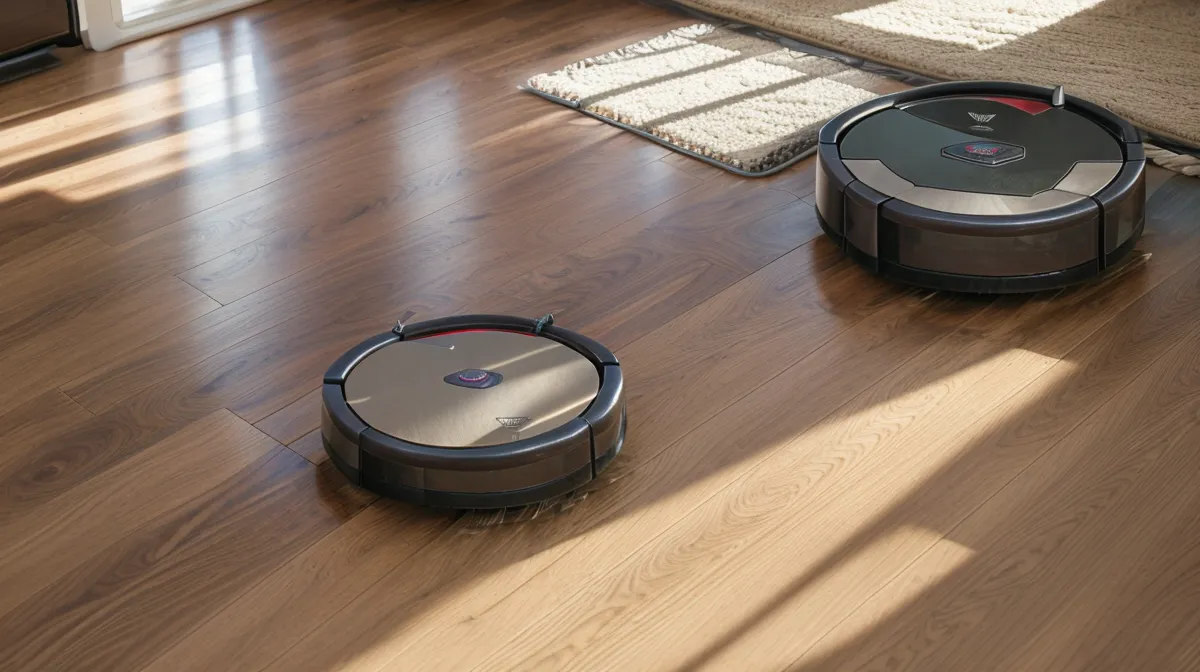
Husky undercoat catches the afternoon light in our living room like glitter, and none of it is decorative. Vacuuming that floor every single day does nothing for the finer beagle dander already circulating past your face. That gap between visible pet hair and breathable air is the myth this whole post is here to correct, and it's why an air purifier ended up next to our robot vacuum fleet instead of replacing it.
Quick disclosure up front, since this one leans hard on gear talk: the PuroAir HEPA 14 Air Purifier link in this piece, plus the robot vacuum links scattered through it, are affiliate links. I get a small commission if you buy through them, at no extra cost to you. That arrangement doesn't change which unit I'd actually tell a friend to buy — the dustbin tally is real, and so is the rest of this.
A vendor at the City Market Indy Winter Farmers Market asked me about this exact split a few weekends back, while I was buying candles instead of doing anything useful with my Saturday. Her Roomba kept the floor spotless, she said, so why would she need anything else for her cat's dander. I didn't have a tidy answer for her on the spot, but I have one now.
Before the PuroAir, my first move was buying the cheapest robot vac I could find, on the theory that a clean floor would eventually mean clean air. It lasted exactly one run before the fringe on our hallway runner ate it, a different bot than the one I've written up elsewhere on this site, for what it's worth. Even if it had survived, it wouldn't have touched what was floating three feet off the ground. Sam still crouches down every so often and points at the strip under the sectional where nothing reaches, and there's a fresh line of gray dust sitting there no matter how many times a robot ran that day.
Why Does HEPA 14 Catch More Than HEPA 13?
Most air purifiers at a big box store carry a HEPA 13 filter, rated to stop particles down to 0.3 microns. HEPA 14 is graded a step above that: certified to capture 99.99% of particles down to 0.1 microns, roughly a third the size. That difference matters more than the spec sheet makes it sound, because beagle dander and the fine undercoat Murph sheds sit well under that 0.3-micron line — the exact range a HEPA 13 filter is allowed to let through. A drafty 1920s house in suburban Indianapolis doesn't help either; air doesn't so much circulate through our place as pool in corners, including ones the Roomba j7+ can't get a wheel into.
Sam's review of the box itself was blunt: "It looks like a Lego brick that got left out in the sun." He wasn't entirely wrong — next to the brushed metal of our LG CordZero dock, the PuroAir's perforated white plastic looks like the budget option it is. The build isn't fancy, and the housing has some flex to it if you press on the corners. What matters is what's inside the housing, not the housing itself.

The Smart Home App With No Schedule Button
As someone who gets paid to write onboarding flows for a living, I have almost no patience left for bad ones by the time I clock out. The PuroAir's app is rough: no real scheduling, just a basic countdown timer, so there's no way to tell it to kick on automatically when the dogs start wrestling at dinner time. You either remember to tap a button or you don't. It's the kind of gap that would get flagged in a design review at any company I've actually worked for.
Run it on high after Murph has a zoomie session on the rug and there's a faint, clean-metal smell right above the vent for the first few minutes, not ozone, just the absence of dog. Where you actually put the thing changes how fast that happens, and I've got a full breakdown of that in my piece on where to put an air purifier for the best indoor air quality if you're working with a floor plan as chopped-up as ours.
A Denser Filter Means a Louder Motor
Nobody tells you this part upfront: the denser a filter has to be to trap particles that small, the more resistance it creates, and the harder the motor has to push air through it. HEPA 14 material is thicker than HEPA 13 by design, which is exactly what makes it good at catching dander and exactly what makes the fan work harder to move the same volume of air.
I checked it with the NIOSH SLM app on my phone, which isn't a lab-grade meter but is consistent enough for comparing rooms in my own house. Sleep mode reads around 28 decibels, quiet enough that it disappears under normal conversation. Cranked to the top setting after a shedding session, it's a low, steady hum you can feel more than hear, and on our hardwood it carries. I ended up moving it onto a rug in the hallway to cut the vibration, the same fix I landed on for the vacuum dock in my piece on the LG CordZero and craftsman trim.
Checking the Filter After a Long Winter Indoors
Winter is the real stress test, since the windows stay sealed and the heat runs nonstop. That's usually when I wake up with what I've started calling beagle-congestion — a scratchy throat from a bedroom where Beans has been shedding into recycled air all night. Running the PuroAir through that stretch, I stopped reaching for allergy meds most mornings, which is the kind of thing you only notice by its absence. Even the X-Sense Smart Smoke Detector in the hallway seemed to be living in a cleaner space — fewer dust-triggered false alarms at odd hours, which says more about air quality than any spec sheet does.
I finally pulled the pre-filter to look at it during a cold snap, and the outer layer had gone gray and matted with dander and undercoat, dense enough that I understood exactly what it had been pulling out of the air. It's the same little crackle you get when a wad of husky undercoat finally lets go of a rubber roller — proof the machine is actually earning its keep instead of just running. If your smoke detector placement is due for a rethink too, I wrote up where to install X-Sense detectors in an older two-story home after chasing down that same false-alarm pattern.
Does the PuroAir Earn a Spot Next to the Robot Fleet?
A 1920s bungalow with two shedding dogs isn't a one-gadget problem, and the purifier only ever covered half of it. On the floor side, mapping speed turns out to matter more than raw suction — my Roborock S8 Pro Ultra locks in a floor plan faster than the others in the current lineup, though the mop pad it's known for is a trade-off of its own: great for finishing touches, not something I'd trust for daily fur pickup on its own.
A UX-writing colleague I trade notes with, Colette — her golden retriever Biscotti sheds like it's a competitive sport — is convinced dustbin capacity beats every other spec on paper, and after emptying enough bins myself, I'm inclined to agree with her.
For daily driving, the LG CordZero is still the one I reach for first, mostly because its app onboarding didn't make me want to throw my phone, and because it holds a charge through the whole downstairs without the suction dropping off toward the end of a run — that battery-versus-suction trade-off is its own rabbit hole I won't get into here. The Roborock S8 Pro Ultra is the one Sam actually likes, entirely because of the mop pad lift. And the Roomba j7+ still holds the title for steering around anything Beans leaves behind on the rug, which matters more than people expect until it happens to them once.
None of that changes the original question from the farmers market: a spotless floor and clean air are not the same purchase, and no robot vacuum, however good its mapping, is going to fix the dander sitting three feet off the ground. If you're dealing with a dog that sheds enough to dust your furniture between vacuum runs, the PuroAir HEPA 14 is the one I'd point you toward — plain plastic, clunky app, and all. Sam still calls it the Lego brick, but he's also stopped complaining that the living room smells like dog, and that's the trade I'd make every time.