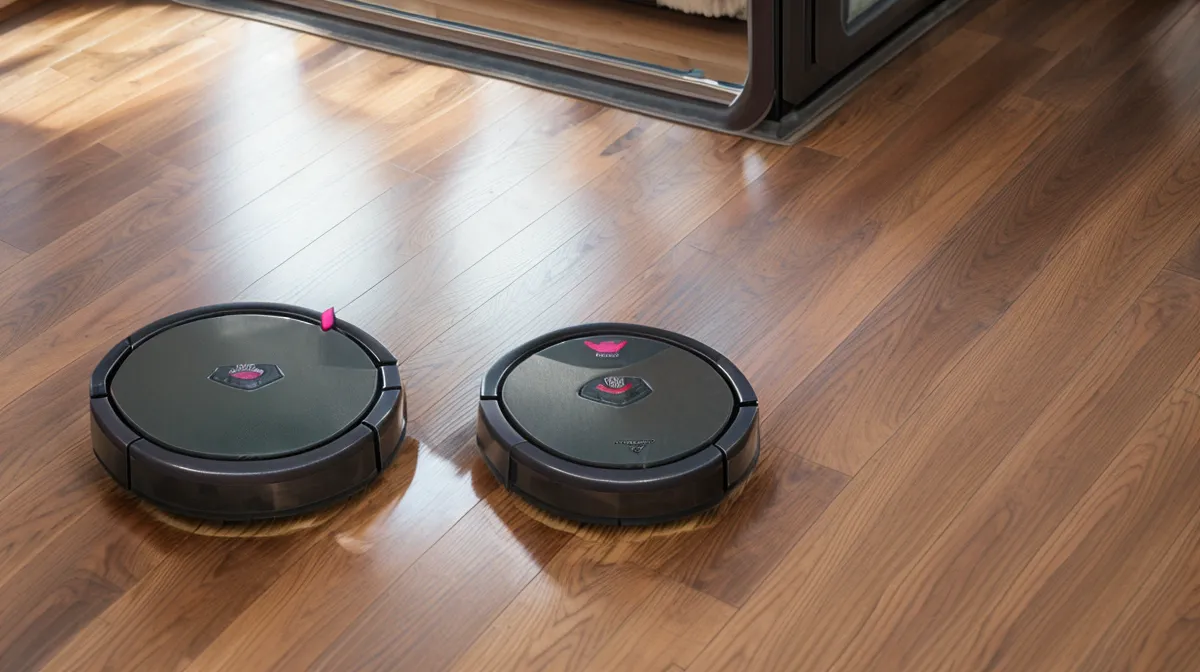
The j7+ is already three-quarters through its arc around Beans's overnight surprise by the time I glance up from my laptop, the front camera doing its little pause-and-recalculate stutter before it commits to the wide loop. No smear. No disaster. Just the Roomba j7+ quietly earning the one line on its spec sheet that actually matters in a two-dog bungalow: pet waste avoidance that holds up when nobody's standing there to intervene.
Quick disclosure before this goes any further: I earn a commission if you buy a vacuum or air purifier through a link in this piece, at no extra cost to you. Every device mentioned here has run through our own house, usually with Sam narrating from the couch like it's live sports commentary. The dustbin tally isn't a bit — it's a spreadsheet I've kept going for two years now, and a bot that can't handle Murph's husky-mix shedding doesn't make the list regardless of what the affiliate payout looks like.
The Myth: A Pet-Waste Camera Means You Never Have to Watch
Here's the misconception I want to take apart, because it shows up in every comment section under a robot-vacuum review: people assume a pet-waste avoidance camera means the problem is solved, full stop, zero supervision required, forever. The tech behind that claim runs on computer vision trained on a narrow, specific object set — solid pet waste, phone chargers, shoes, loose cords — not a general intelligence that understands "don't ruin my floor." It's pattern-matching, and pattern-matching fails the moment something falls outside its training set.
The iRobot Roomba j7+ is the unit that convinced me the camera earns its keep anyway. It showed up in a box that, for once, wasn't the size of a refrigerator, and the front-facing camera — iRobot calls it PrecisionVision Navigation — is the reason Beans's overnight surprise became a wide arc instead of a smear across the hallway.
iRobot backs the feature with what they call the P.O.O.P. promise — Pet Owner Official Promise, and yes, I have to type that with a straight face. It guarantees a replacement if the unit fails on solid waste. It says nothing about liquid messes, nothing about a treat that got smeared before the bot arrived, and nothing about whether the camera can see anything useful once the house goes dark. That's the gap the myth glosses over, and it's the gap that actually matters when you're deciding whether to trust this thing while you're not home.
Does the Mapping Actually Hold Up in a 1920s Floor Plan?
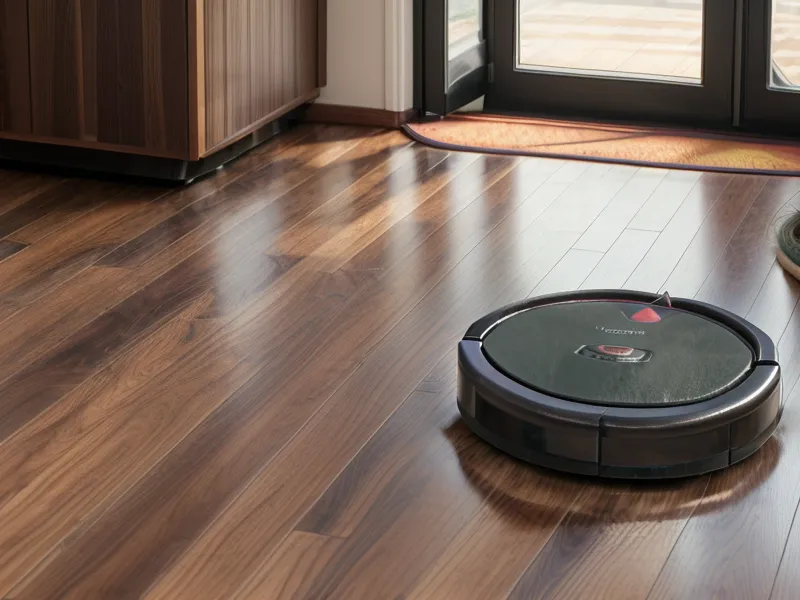
Old floor plans don't map cleanly, and the j7+ needed three full runs before the layout stabilized — high door thresholds and a stubborn corner near the sectional don't make it easier. The Roborock S8 Pro Ultra usually locks in by run two on a similar layout, for context, though the Roomba gets there eventually. Once it does, editing the no-go zones is its own headache: re-save the map and the app frequently forces you to redraw every boundary from scratch, which is the kind of friction that makes a broom look appealing again.
Mapping accuracy versus how fast a bot commits to its own map is genuinely a separate topic — I go deep on it in Best Robot Vacuum for Bungalow Floor Plans With High Door Thresholds.
The 2 A.M. Notification That Changed My Trust Level
My phone buzzed at 2 a.m. with a push notification announcing the j7+ had just wrapped a "clean cycle" nobody scheduled, while both dogs were asleep in the hallway and the house was pitch dark. "Why is the vacuum awake before we are," Sam mumbled, half asleep, when the phone glow woke him too. Even the startup chirp — the same three notes every time, but somehow sharper bouncing off the door trim in that front hallway than it sounds anywhere else — felt like an alarm at that hour instead of routine background noise. Colette, the UX-writer friend I text the second a companion app does something inexplicable, got the screenshot within the minute, and her read matched mine: a robot deciding to run itself at the hour when the camera has the least light to work with is exactly the scenario the P.O.O.P. promise doesn't cover well, guarantee or no guarantee.
Sam usually walks Murph and Beans along the White River Greenway path in the evening, which is the actual window the j7+ uses to run solo most days, and daylight through the front windows during that stretch is decent. A phantom 2 a.m. cycle is a different animal entirely, and it's the clearest argument I've got against treating "avoidance" as a substitute for knowing when your robot is actually running.
Moving the Dock Didn't Solve Coverage — It Just Blocked the Hallway
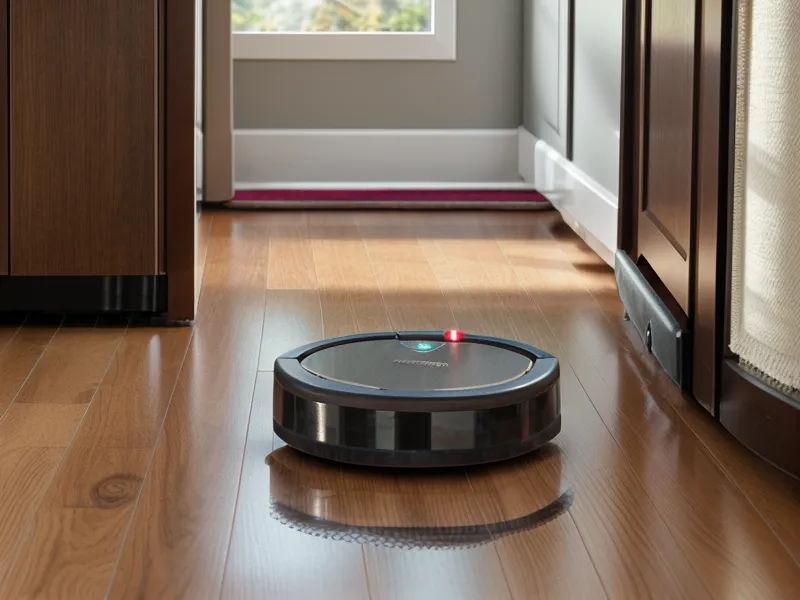
Coverage gaps near the back of the house made me try the obvious fix: relocate the dock to the hallway, closer to the rooms it kept skipping. That didn't last — every trip to the kitchen meant stepping around a charging robot parked in the one narrow stretch of hallway we actually walk through constantly, and the coverage gaps didn't close anyway. The back rooms stayed an afterthought regardless of where the dock sat. It went back to its original spot, and the real fix turned out to be redrawing the zones patiently instead of relocating hardware.
The Fur Math That Changes Every Number Here
None of the mapping or avoidance talk matters if the bin fills before the bot finishes a room, and that's where Murph's shedding turns into its own variable. The self-empty base helps, but the onboard bin is small enough that heavy fur can bridge across the sensors before the system registers it needs emptying. Suction strength versus battery life is a separate trade-off entirely, and one the j7+ doesn't need to win to stay in rotation. Whether a mop pad is worth the added noise floor is its own argument too, and not one I'm settling here. For raw fur volume, the LG CordZero Robot held up better across our hardwood and the bedroom rug than anything else I've run, and its onboarding didn't demand an account just to start a cleaning cycle.
The Subscription Nag Nobody Warns You About
As a UX writer, the "nag" patterns are the part I can't unsee. A third "Upgrade to Premium" pop-up in two weeks, for a machine I already own outright. No. The app is clean, functionally, but it increasingly reads like a captive marketplace for bags, filters, and a subscription called iRobot Select. Compare that to the PuroAir HEPA 14 Air Purifier, whose filter-replacement reminders are honest instead of gamified into an upsell. That true HEPA filtration grade is a deeper topic on its own, one I get into properly in Testing the PuroAir HEPA 14 Air Purifier for Persistent Dog Dander. Where you physically put that purifier in a room matters almost as much as which one you buy, which is a placement question for another post entirely. It's the same logic that made me reconsider where our smoke and CO detectors sit upstairs: a sensor, or a filter, is only as good as its position.
So, Is the P.O.O.P. Promise Worth Trusting?
For a smart-home pet owner trying to decide whether the j7+ earns its spot over a Roborock or an LG, here's the actual rule, not the marketing version: trust the avoidance camera for solid, formed messes in normal daylight, and don't ask it to make judgment calls in the dark or on anything liquid. The dustbin-capacity question deserves its own full breakdown, which I already gave in Six Robots Later: Why I Finally Stopped Swapping Vacuums in This Two-Dog Bungalow.
If you've got a senior dog with the occasional bad decision, or a "creative" eater like Murph, the Roomba j7+ earns its keep specifically because of that camera. Just go in knowing what it's actually promising, not what the myth says it promises. Pairing it with something like the PuroAir Air Purifier covers the part of the mess the vacuum was never going to reach in the first place: the dander that's already airborne by the time the bot shows up.