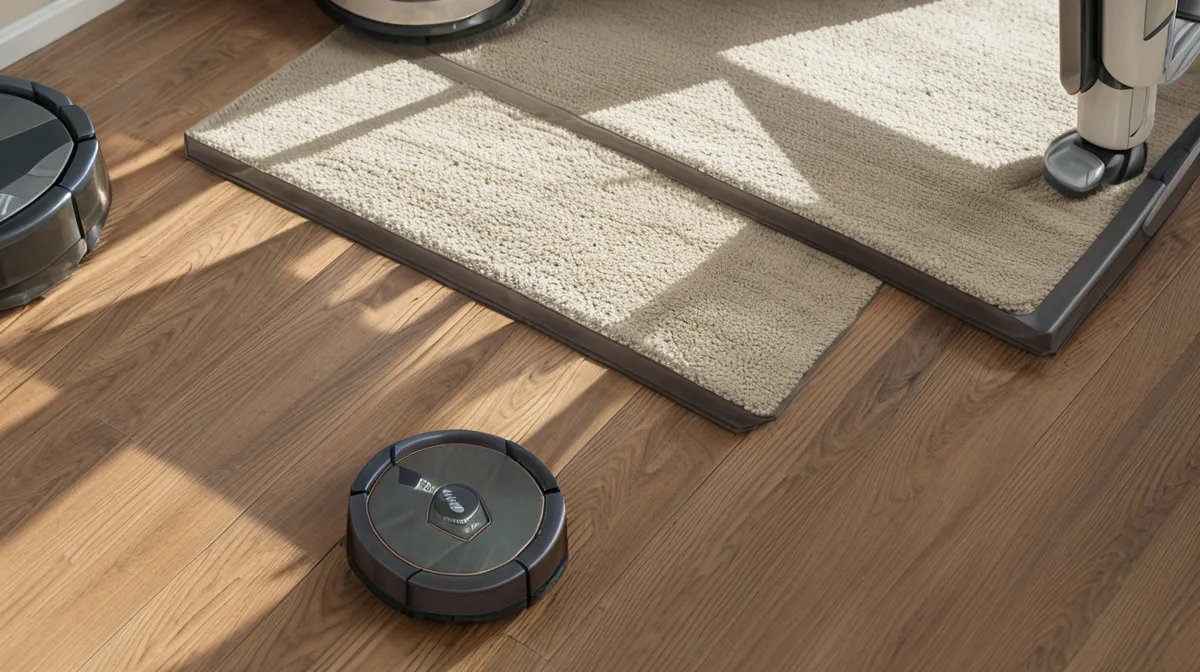
Six robot vacuums have cycled through this house, and exactly one of their dustbins has gone a full week without me touching it. That single fact ended up deciding more of this robot vacuum review than any spec sheet, star rating, or app promise ever did.
Quick disclosure before this turns fully into a buying guide: some of the links ahead are affiliate links, and if you use one to buy the LG CordZero, the Roborock, or the smoke detector, I earn a small commission. None of that touches which bot got benched or which one earned a permanent spot by the back door — the dustbin tally doesn't know what a commission is, and neither does Murph.
What Mapping Speed Actually Costs You
Navigation is where most of this gets decided, not suction. A robot vacuum's spec sheet talks about suction like it's the whole story, but in a house with two shedding dogs and one very confident runner rug, the real fight is between mapping precision and how long you're willing to babysit the thing. Bots that start cleaning five minutes out of the box are usually the ones calling for help from under the furniture ten minutes later. Bots that take a slow, deliberate first pass — building the floor plan before committing to a route — are the ones that stop calling. That trade-off is the whole logic behind the tracking tally I keep on every bot that comes through here.
The LG CordZero Robot sits on the patient end of that spectrum. Sam and I lost a whole Saturday morning watching it work the house corner by corner before it earned the right to run unsupervised, and neither of us loved giving up the morning for it. Coverage was the actual problem worth solving, though. Before landing on the LG, I tried fixing a different bot's blind spots by relocating its charging dock to the hallway — more central, shorter trip back, fewer stranded-bot alerts, or so the theory went. What actually happened was two weeks of everyone in the house stepping around a dock parked in the one hallway we all use constantly, with the same coverage gaps sitting exactly where they'd always been. The dock was never the problem. The map was.
Battery life matters here too, in a way suction specs alone can't cover. A stronger motor doesn't help much if the bot taps out halfway through the rug and parks itself to charge before finishing the route it just spent ten minutes mapping. Low-clearance furniture is its own category of failure — shorter bots have a habit of sliding partway under something and just staying there until a human intervenes, which no amount of mapping precision fully solves.
The Shed-Off: Dustbins, Brush Rolls, and One Genuinely Good App Trick
By the height of shedding season I was running a three-way test between the LG, the Roborock S8 Pro Ultra, and the iRobot Roomba j7+ that had been doing daily duty before any of this started. Each one has its own personality, and not all of them are pleasant to live with. The Roomba's auto-empty base has a seal tight enough that dust never leaks back into the hallway, which is more than I can say for two of the other docks I've run, but its dustbin is noticeably smaller than the LG's for the same square footage, so the same shedding week means emptying it more often regardless of how well it seals. It also, to its credit, recognized solid waste on the floor and steered around it instead of smearing the evidence into the rug, which mattered exactly once, at a moment I'd rather describe in the past tense and move on from.
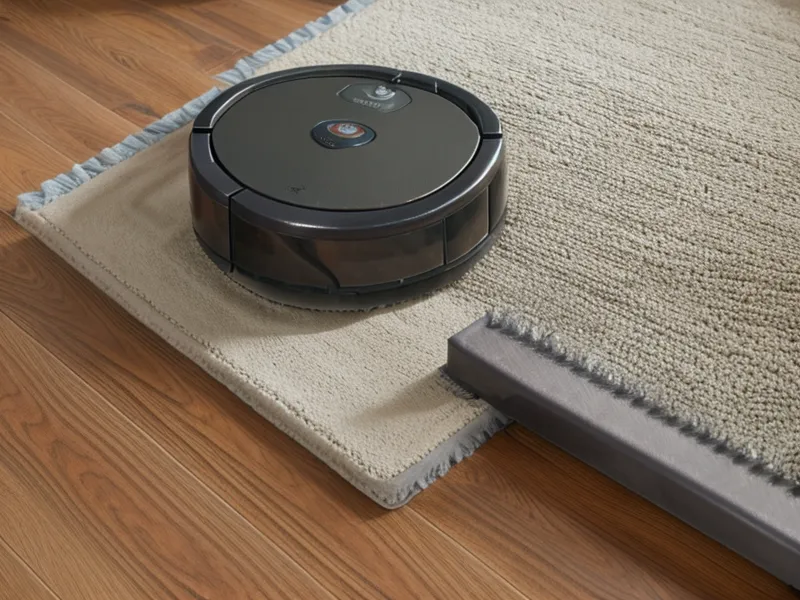
The Roborock earns real credit for one trick: mop pad lift. On a muddy afternoon after the dogs had tracked in half the yard, I watched it cross from tile to rug and lift its own mop pad mid-route, no phone involved, and Sam made an actual impressed noise under his breath, which almost never happens during an app demo in this house. That's the mop-versus-vacuum trade-off in miniature: a mop function that good is genuinely useful on hard floors, but it's dead weight on a rug-and-fur problem, which is most of what this house has. The app around it, though, is dense enough to feel like a SaaS dashboard when all you wanted was to skip one room.
Brush roll tangling is the maintenance cost nobody puts in the marketing copy. The LG needs its roller unwound by hand after roughly ten runs of picking up two dogs' worth of fur. A cheaper competitor in the same size class, the Dreame L20 Ultra, needs the same fix every five or six runs instead — about half the interval for a job nobody wants to do standing in the hallway with pliers. Colette Morrow, a fellow UX writer I trade notes with who's raising a golden retriever named Biscotti of her own, texted mid-review to argue that dustbin capacity should be the headline spec on every listing page instead of buried in paragraph six behind suction numbers nobody can actually picture. Hard to disagree after watching bins fill at six different rates. The LG CordZero Robot eventually pulled ahead of both of them because it handled the hardwood-to-rug transition without a single stuck notification through the entire season — the fuller log of how that held up lives in my Shed-Heavy Household Survival Guide, if the dustbin math alone doesn't convince you. Its own auto-empty dock announces itself with one hard pull of suction late in the evening, right when the house has actually gone quiet enough to notice.
Cleaner Air Is Part of the Job Too
Running that many vacuums through the same rooms kicks up more fine dust than any single cleaning pass accounts for, which is the argument for treating air quality as part of the same routine instead of a separate purchase later. Most consumer purifiers top out at HEPA 13; the PuroAir HEPA 14 Air Purifier sits a tier above that, rated for finer particles — the deeper explanation of what that grade actually means belongs on a page built for it, not this one, so I'll leave the HEPA rating breakdown there.
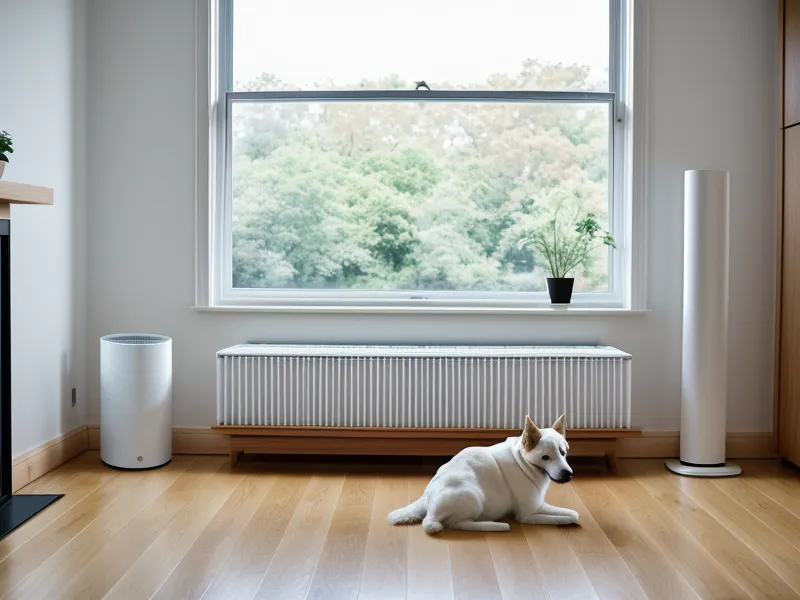
Placement mattered more than expected. It lives in the hallway between the bedrooms and the living room, pulling air from both directions instead of sitting in one corner doing nothing for the rest of the floor plan. Sleep mode reads 28 decibels on the meter three feet away, closer to a quiet room than to a running appliance, which is the reason I can work near it without reaching over to shut it off. Filter replacement runs on an honest schedule in the app, too — no gamified low-filter panic pushing an early reorder, just a plain readout of what's left. It also does something none of the vacuums can touch: the dog smell that used to build up in that hallway by evening is just gone, which no amount of suction or mapping ever fixed. Anyone dealing with pet allergies in a smaller floor plan than this one should look at my notes on best HEPA air purifiers for pet dander instead — this piece stays focused on how the purifier and the vacuums work as one routine, not as competing purchases.
Where the Smart Home UX Falls Apart
App onboarding is the part no marketing copy mentions, and it's the part that actually decides whether a device gets used past its first week in the box. Pairing the X-Sense Smart Smoke and CO Detector turned into a lost afternoon. Like most smart home hardware, it insists on a 2.4GHz band, and my mesh router kept bumping the connection to 5GHz mid-pairing, which the detector flatly refused to accept. I ended up standing at the far edge of the backyard, past where the 5GHz signal actually reaches, just to force the phone onto the right band long enough to finish setup.
Placement got easier once pairing was done: one unit in the hallway outside the bedrooms, one in the kitchen, none directly over the stove where cooking steam sets it off for no reason. These units talk to the app individually rather than to each other, so a kitchen alert doesn't automatically flag the bedroom units the way a fully interconnected hardwired system would — worth knowing if that's what you're used to. Notification timing turned out to be the real win: the app fires a push alert before the horn even starts, which is the difference between silencing a false alarm calmly and having Murph and Beans stage a full neighborhood announcement over burnt toast.
Not every notification earns its place, though. One night the LG's app pushed through a message that a cleaning cycle had started, timestamped for an hour when nobody in the house was awake to ask for it, let alone approve it. The bot had simply decided, on its own internal schedule, that it was time. Compared to a smoke detector deciding when to interrupt you, a vacuum doing the same thing feels less like safety and more like an app that hasn't figured out who its actual boss is.
Which Bot Actually Earns the Permanent Spot?
After running all of this side by side, the answer for a house that's more dog hair than floor is the LG CordZero Robot. It's the only one that never needed brushroll surgery every few days, the only dustbin that survives a full week of fur, and the only app in the lineup that didn't nag, stall, or require a backyard pilgrimage to finish setup. The mapping takes longer up front, and the price sits well above the budget options in this category, but not fielding a single "help me" notification while trying to work is worth the trade for anyone doing serious home maintenance in a shedding household.
The Roborock S8 Pro Ultra stays the better call for a house that's mostly hard flooring and regular mud, since that self-cleaning mop earns its keep in exactly that situation. For a rug-and-fur problem specifically, the LG's edge and trim cleaning around craftsman-style baseboards is the more reliable habit to build a routine around — it gets into corners the round-bodied bots either skip or fight with. Between an app that respects your time and dogs that stop howling every time a dock cycles, that's the version of pet owner tech worth actually paying for. If any of this sounds like your house, the LG CordZero Robot card below has the full breakdown and the link to go grab one.
LG CordZero Robot
Pros
- + Handled a mix of hardwood and high-pile rugs without getting stuck once in three months
- + The auto-empty bin actually manages a full week of husky fur without clogging
- + The app interface is surprisingly clean and doesn't nag you for subscriptions
Cons
- − Initial mapping takes much longer than cheaper 'bump-and-go' models
- − The premium price is a steep jump if you don't have heavy shedding dogs