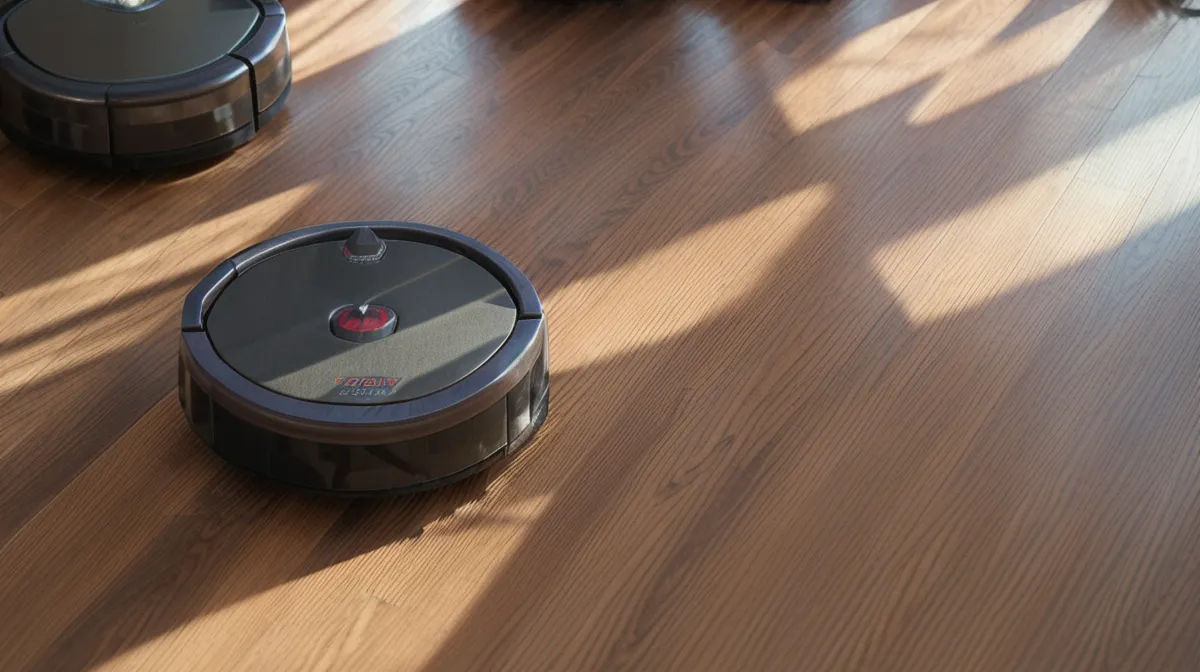
Eleven minutes. That's how long our newest robot vacuum lasted before it sent a "bin full" alert, on a stretch of hardwood that had been clear an hour earlier. It had announced itself with its usual startup chirp, the kind that makes Beans lift his head off the rug for a second, like it was ready for a real shift. Murph, my husky mix, was mid-shed, dropping enough undercoat to reupholster a couch, and the bot had tapped out before it got anywhere close to done. I log runs like this in what I call the dustbin tally, a habit that started after the Roomba i3 died on our basement steps, and the entries keep saying the same thing: robot-vacuum longevity in a husky household has less to do with the spec sheet than with a pet-hair maintenance routine most owners never bother to build.
The Basement Graveyard Behind This Guide
Three dead robot vacuums live down there, plus one that technically still runs but lost most of its dignity to an IKEA rug fringe in a single pass. That one was a budget pick, grabbed cheap after the first bot died, and it never recovered — the fringe wound so tight around the brush that the motor gave up trying. This isn't a hobby anymore. It's closer to a survival tactic for a 1,200-square-foot craftsman bungalow with two dogs shedding on a rotation.
Murph's coat sheds like it's trying to insulate the whole crawlspace, and Beans, my senior beagle, contributes a finer dander that coats every sensor until a bot starts drifting like it's lost. "Another one down?" Sam asked, when the budget replacement finally quit. Yes. My friend Colette Morrow, a UX colleague I trade notes with, isn't convinced four data points make a real pattern — she pushes back every time I call a new bot "better," which is fair, and it's part of why the tally tracks specific, repeatable things: how full the bin gets after one pass, how the motor sounds on hardwood versus rug, how many days pass before a bot needs help.
Why I Stopped Trusting the Self-Emptying Base
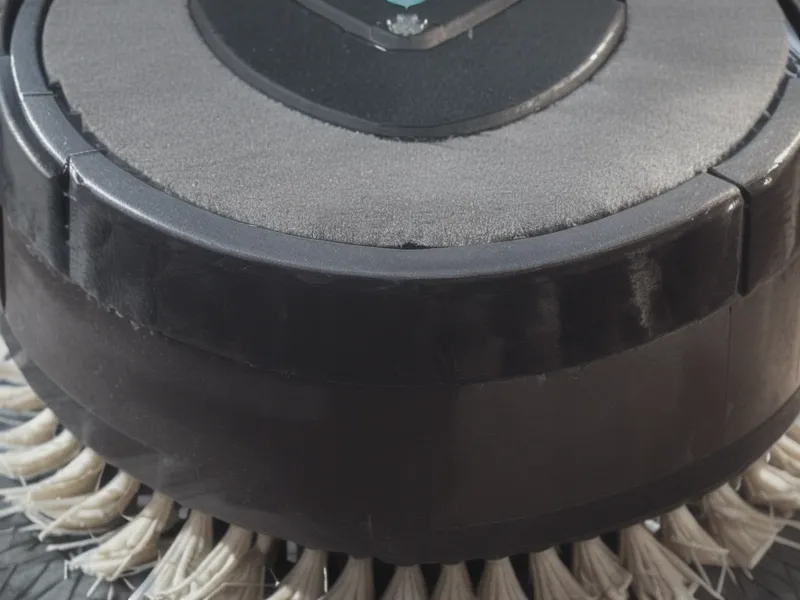
A self-emptying base sounds like the fix for a shedding household, and for the first stretch of use, it feels like one — right up until it starts hiding a real problem. The base clears loose hair from the bin but leaves the tight tangles wound around the brush-roll axle exactly where they are, so a motor can be straining for a good while before it throws any error at all. I don't take the bin-full sensor's word for it anymore, and I don't take the app's word for it either — I weigh the bin myself after a run, the same practice behind my Tracking Tally: Which High-End Robot Vac Actually Survives Two Shedding Dogs?, because a gram reading tells you more than a green checkmark ever will.
The Blind Spots That Wear a Bot Out Faster
Sunlight through the front windows can wash out a LiDAR sensor's read on the room, and dust on the sensor glass makes it worse — that combination is well documented elsewhere, so I won't relitigate the mechanics here. What matters for a bot's lifespan is what happens next: one that can't see clearly bumps the same furniture leg over and over and burns through brush-roll life faster than a bot running a clean map. The LiDAR and the HEPA filter both get marketed like they solve themselves, but a filter only helps if air can actually move through it, and a sensor only helps if it isn't caked in fluff.
Low clearance under furniture causes its own kind of wear — a bot that can't quite fit gets stuck trying, wheels spinning against the frame until the motor overheats. Sam still points at the gap under the sectional some mornings, the floor there dustier than the rest of the room, proof the bot never fully commits to that stretch. The same caution matters around the open stairwell off the kitchen, where a cliff sensor has to get the call right every single time — the Roomba i3 didn't, and that's still the reason the basement graveyard exists at all.

Listen for the Motor Before It Fails
There's a baseline hum on hardwood that fades into the background after a while, and then there's a higher, strained whine that shows up on the runner rug in the hallway — that pitch change is the reliable tell that the brush roll is fighting something. I don't need a meter to catch it anymore, just an ear tuned to the difference. Sam usually calls out "is it dying again?" from the other room, and more often than I'd like, the answer is yes.
Most "tangle-resistant" brush claims fall apart at the axle bearings, not the brush itself. That's the detail no marketing copy mentions. So I check mine every week: pull the brush, clear the bearings, done in about five minutes. Skip that step long enough and you're not looking at a quick fix anymore, you're looking at a motor housing melted from the friction — a far more expensive problem than five minutes would have cost you.
Building a Maintenance Routine the App Won't Suggest
None of this needs to be complicated, but it does need to be consistent, and that's the part the companion apps never mention. Too busy pushing a filter subscription before you've even paired the thing. My own routine is a kitchen scale, a pair of seam rippers for the axle bearings, and very little trust in whatever the app reports. I don't rely on the bin-full alert in a house with this much fur; I set a manual reminder instead, and I check the brush roll on a schedule regardless of what the sensor claims. If you want the fuller breakdown of which bots actually hold up under this kind of shedding, that's what my Shed-Heavy Household Survival Guide covers in more depth.
The other habit worth building: don't trust a bot's first map. The first mapping run always lies, especially in an older house with settled floors and a stubborn rug fringe near the entry, so I babysit any new bot through its first handful of runs until it treats that fringe like a hazard instead of a snack. It's more hands-on than the box promises. But between a husky who sheds like it's a job and a beagle who won't move out of the way, hands-on is the only version of "convenient" that actually keeps a robot vacuum running.