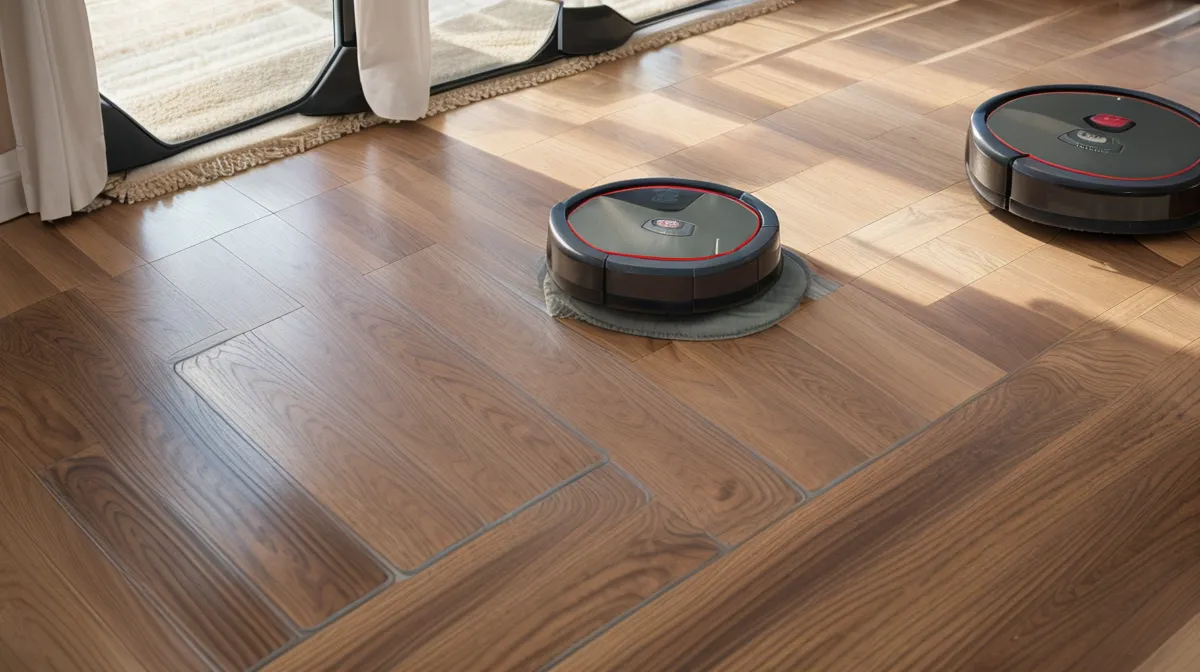
A spray mop needs someone kneeling on the floor with a rag. The Dreame L20 Ultra needs one motor-driven arm that swings a round mop pad a couple of extra inches past where its own body stops — exactly the strip of hardwood where Murph and Beans, our two shedding rescue dogs, leave the thickest tracks after a muddy loop on the Monon Trail near Nora. That gap between what a person can reach with a rag and what a machine can reach with an extending arm is the whole pitch behind this bot, and it's why a pet-hair-management problem in our 1920s craftsman bungalow finally turned into a smart home cleaning setup instead of a Sunday chore — which is what this robot mop review is actually about.
Quick disclosure before the mechanism talk: I earn a commission if you buy through the links here, this sits on the same running list I've been keeping since a Roomba i3 died on our basement steps, and every number below comes off my kitchen scale and a decibel app, not a spec sheet I copied. I call that list the dustbin tally, and this is one more entry in it. If you're deciding whether a high-end robot vacuum is worth the money for a house full of dog hair, the mechanism matters more than the marketing copy, so that's where I'm starting.
Manual Mopping vs. the MopExtend Arm
Craftsman-era floor plans like ours come with Craftsman architecture quirks that most robot vacuums handle badly: taller door thresholds between rooms, uneven transitions where the oak meets tile in the kitchen, and baseboard corners that collect dog hair like a magnet. Most bots I've run through the dustbin tally just bump the corner and move on, leaving a strip of hair and grime along the trim that I'd otherwise be doing by hand.
The Dreame L20 Ultra is built around one answer to that specific problem: MopExtend. When the bot's sensors register a wall or a corner, a small motor pushes one of the two round mop pads out on a hinge, past the edge of the chassis, so it can actually scrub into the trim instead of stopping short of it. It's a mechanical solution to a geometry problem, not a suction upgrade, which is worth knowing going in — this feature is about reach, not raw cleaning power.
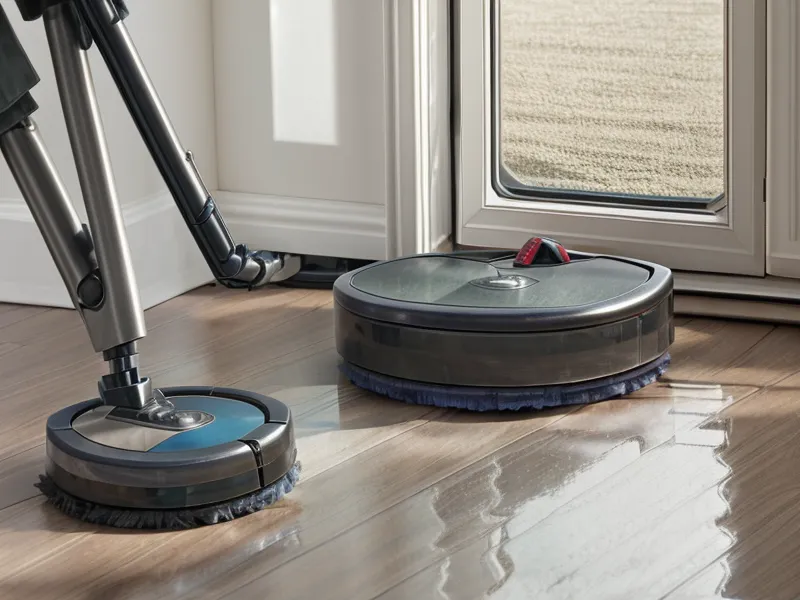
Sam watched the arm kick out over the corner behind the sectional — the same corner every other bot has skipped — and said, "Okay, that's actually doing something," which from Sam counts as an enthusiastic review. That sectional clears the floor by less than three inches, and only a handful of the bots I've tested fit under it at all — the corners just past its legs are exactly where the MopExtend arm earns its keep.
How accurately a bot maps a layout like this in the first place is a bigger topic than one review can cover — I get into the mapping-speed comparisons in my Best Robot Vacuum for Bungalow Floor Plans With High Door Thresholds notes. For this review, what matters is that once the L20 has a room mapped, the MopExtend arm fires reliably on repeat runs, not just the first time it meets a new corner.
How Deep Mopping Mode Handles Salt-and-Mud Slurry
Indiana winters bring a specific gray-brown slurry in on dog paws — road salt, mud, and melted snow mixed into something a dry mop just smears around. Deep Mopping mode on the L20 is built for exactly that: the pads apply downward pressure and scrub in a back-and-forth motion instead of the single-pass wipe most mop-equipped bots default to.
Unlike the iRobot Roomba j7+, which is a strong vacuum but treats mopping as an afterthought, the Dreame is built mop-first. That comes with a cost: the swinging arm and the extra pressure mechanism mean more moving parts sitting in a fine layer of Murph's fur and winter grit, which translates into more base-station upkeep than a fixed-pad design needs.
Whether that trade — better edge and slurry cleaning against more maintenance — is worth it depends on how much you actually mop by hand right now, and that's a bigger question than this review alone can settle for every floor type.
Is the Base Station Too Loud for an Old House?
Sound carries differently in an old house with plaster walls and hardwood floors than it does in new construction with carpet and drywall everywhere. That matters here because the L20's base station makes a genuinely loud noise when it's emptying the dustbin — not a background hum, a noticeable several-second roar.
Running the NIOSH sound-level app on my phone next to the dock during an empty cycle gave readings well above conversation level, loud enough that I don't schedule runs during a work call. Compare that to the PuroAir HEPA 14 Air Purifier, which measured a genuinely low 28 dB three feet away on its sleep setting — the two devices aren't doing the same job, but the gap in how they sound in the same room is real.
Where you physically place a purifier in a room changes that number more than most spec sheets let on, which is its own topic separate from anything the mop bot does.
Setting Up the App: Mapping, No-Go Zones, and the 2.4GHz Fix
The app is where this review turns into a rant. Nested modals. Confusing permission screens. A setup flow that feels like it was designed by someone who has never had to explain a form field to a stressed-out user — which, as a UX writer, is basically my day job, so I notice.
Mapping itself moved fast. The No-Go Zone editor did not — it kept timing out until I dropped my router to a 2.4GHz band, the same fix I ended up needing for the X-Sense Smart Smoke and CO Detector when its hub wouldn't pair. Where you physically install a smart detector versus where you draw a no-go zone on a floor plan are different problems, but the wireless troubleshooting underneath them is basically identical.
I tried putting our old Roomba i3 on a fixed daily timer once, on the theory that a predictable schedule would keep it from wandering into trouble while we were out. It didn't work. I came home to a dead bot marooned somewhere that felt like three houses down from its own dock, timer expired, battery gone, waiting for someone to carry it back by hand.
Beans sleeps through all of it, every time — the dock's error light blinking red in the kitchen doesn't register to a nearly-deaf senior beagle, so the actual first sign of trouble is usually me stepping over a stalled bot in the hallway before any notification ever reaches my phone.
Dreame L20 Ultra vs. LG CordZero vs. Roomba j7+
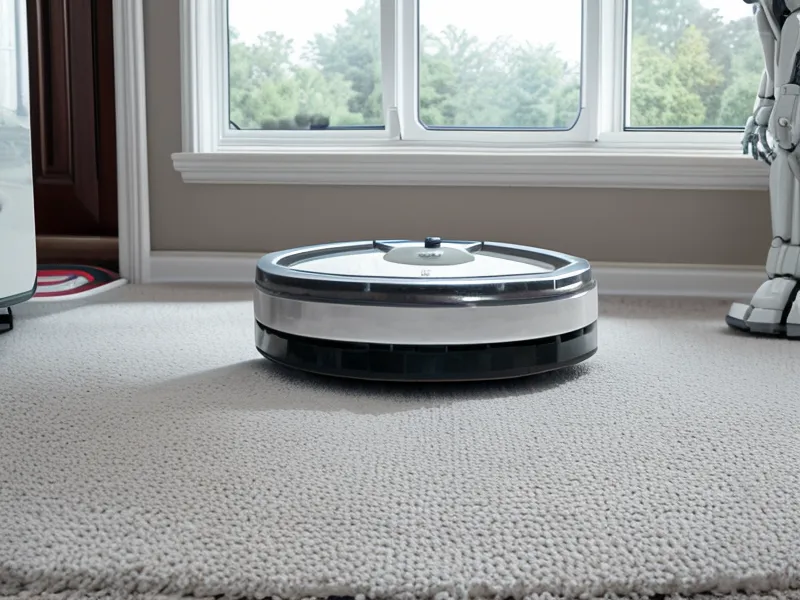
Stack the L20 up against the LG CordZero Robot and the numbers split by surface. The LG still wins on our thick hallway runner rug, but on hardwood, the Dreame's suction spec sits in the same bracket as the Roborock flagship for under half the price on paper — which is the whole reason it's positioned as the budget pick in this lineup rather than the one I'd tell someone to buy first.
Mopping is where the L20 pulls ahead of the Roborock S8 Pro Ultra in corners specifically, thanks to that extending arm — though the Roborock's mop pads lift the instant they detect carpet, snappy enough that it's the one feature this cycle that got a genuinely impressed reaction out of Sam.
Pairing either bot with a PuroAir HEPA 14 catches the fine dander that even a good vacuum kicks back into the air instead of trapping. What actually separates a true HEPA 14 filter from the lower-grade filters on cheaper purifiers is a longer conversation than fits in a mop review, but it's worth knowing the grade isn't just marketing shorthand.
The j7+ also does a specific pet-waste avoidance trick worth knowing about before ruling the brand out on mopping alone — I go deeper on that and the rest of the comparison in Roomba j7 Plus vs Roborock S8 Pro Ultra for Pet Hair. Suction versus battery life is another trade-off that shifts depending on square footage, and it plays out differently across this whole lineup than the spec sheets suggest.
Weekly Bungalow Maintenance the Spec Sheet Doesn't Mention
Every few runs, the dustbin goes on our kitchen scale — the digital display always flickers between two numbers for a second before it settles, which is oddly satisfying and drives Sam a little nuts, but it's the only way I've found to actually compare how full a bin gets between bots instead of just eyeballing it. Dustbin capacity itself varies more between these machines than most spec sheets admit, which is its own separate comparison from anything mopping-related.
Brenley Hessler, a reader I trade notes with on r/robotvacuums, runs the same weighing routine on her own bots — except her floors are laminate, not hardwood, so when her numbers land lower than mine for a similar dog count, it's a useful reminder that floor surface moves these results almost as much as the bot itself does.
Our basement stairwell off the kitchen doesn't have a permanent gate, so setting a no-go zone around it is the first thing I do with any new bot before trusting it to run while we're out — that's less about this particular bot and more a standing rule for any open stairwell in an older floor plan.
For the L20 specifically, the trade for that extending mop arm is a Saturday chore: pulling the wash tray out of the base station and clearing the sludge the self-clean cycle doesn't fully rinse away. If a lower-maintenance hardwood setup matters more to you than corner reach, my LG CordZero Robot Vacuum Review for Older Homes with Hardwood Floors notes cover that trade in more depth.
Final Verdict: Who the L20 Ultra Actually Fits
The decision point is narrower than the marketing makes it sound. If your floor plan has low-clearance furniture and baseboard corners a round bot consistently misses, the MopExtend arm buys back real cleaning coverage, and the extra base-station upkeep is a fair trade. If your layout doesn't have those specific pinch points, you're paying for a mechanism you'll rarely notice working.
Pair it with a HEPA 14 grade filter for the dander a mop bot was never going to catch anyway, and budget the Saturday tray-cleaning into your routine before you commit. If corner coverage on hardwood is the problem you're actually trying to solve, the Dreame L20 Ultra is worth adding to your own dustbin tally.