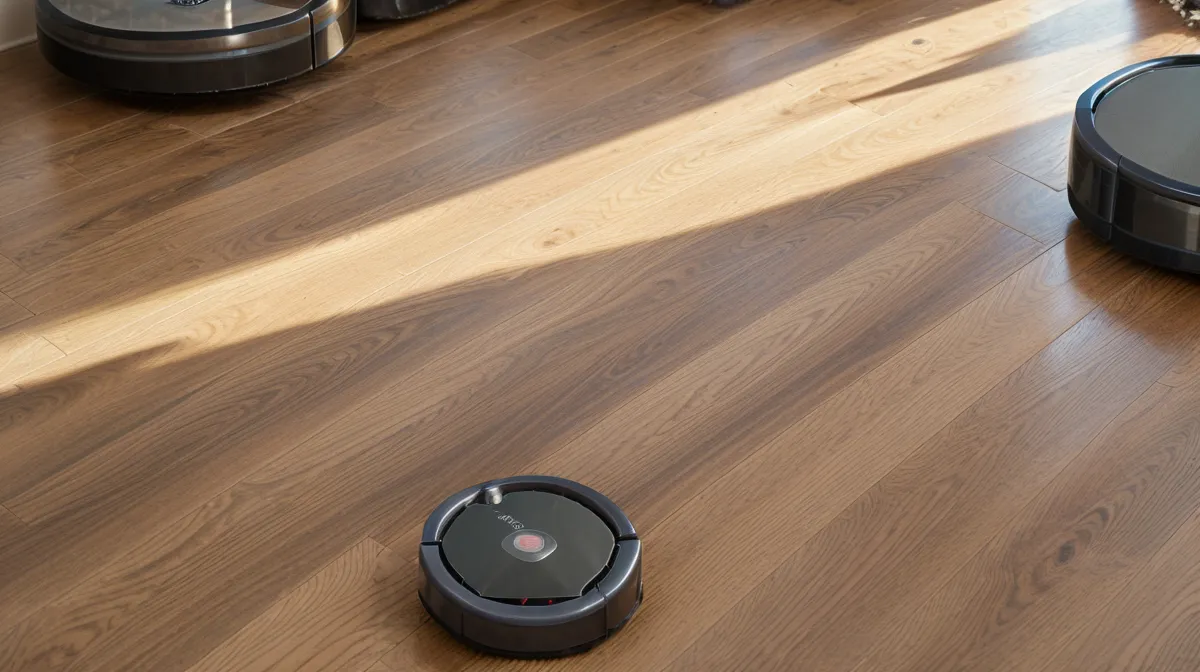
When your robot vacuum finishes mapping the whole first floor without a hitch and then suddenly stops dead at the edge of an area rug, spinning in place like it's staring over a cliff that isn't there, what actually happens mechanically isn't immediately clear. I didn't have a real answer for a long time either, which is roughly how long Beans has been quietly inheriting all the pet hair that piles up along that one border the bot refuses to cross.
Most of what lands on that rug came home from the Broad Ripple Park dog trail in the first place — mud, burrs, whatever Murph rolled through — so when the bot won't cross the border, basic pet-hair maintenance turns into kneeling down with a dustpan instead. One afternoon the basement door was standing open when I looked up from my laptop, and the bot had already worked its way to the top step, one wheel hovering past the edge, the exact kind of close call that's the whole reason cliff sensors exist and the whole reason I'm careful about touching them.
The Smart-Home Troubleshooting Nobody Explains Well
Cliff sensors work by firing a small pulse at a specific infrared sensor wavelength down at the floor and timing how fast it bounces back; no return signal reads as no floor, and the bot stops rather than risk a fall. The full breakdown of how different bots handle an actual stair drop is really its own subject, and I'd rather point you toward whoever's run that comparison properly than redo it badly here. What gets missed in most explanations is that a rug with a near-black border does almost the same thing to the sensor that a real drop-off does, because dark fiber absorbs that light pulse instead of bouncing it back. The bot isn't malfunctioning. It's reading the information it has, and the information is wrong.
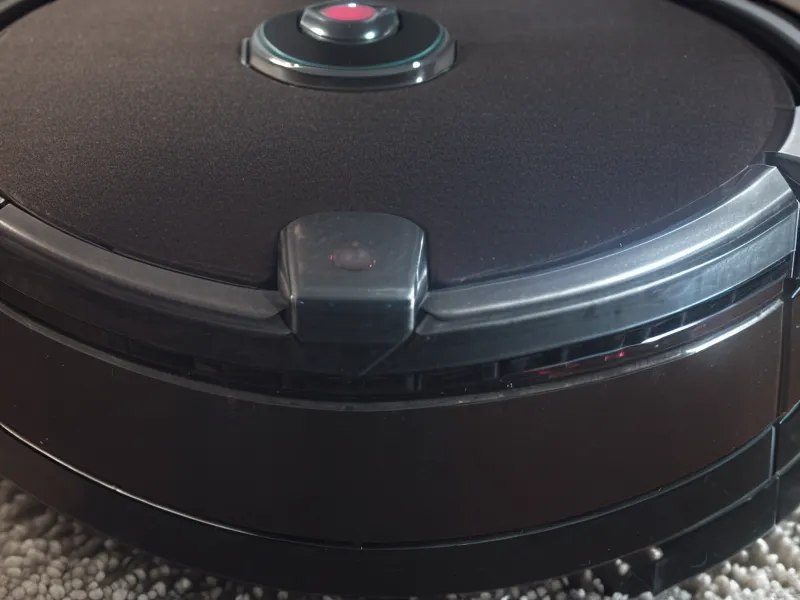
That explains the little island of pet hair I kept finding stuck right at the rug's edge during shedding season — the bot was cleaning everywhere except the one border it had decided was bottomless, so loose fur from Murph just drifted there and sat. It also explains why scrubbing the sensors with a cotton swab did nothing, which I only figured out after trying it on a rug that wasn't even dirty under the lens. For a while I was convinced the real problem was interference on our standard IoT frequency band, something lagging in how the map synced, and burned an afternoon chasing that theory before admitting it was just physics. Tangled-brush alerts are a separate headache entirely, and nothing about tape or an app setting touches that one.
Two Fixes That Attack the Problem From Opposite Ends
None of this is the only wrong turn I've taken chasing a fix, two years into logging these runs now. Long before the rug border became today's focus, I swapped an entire machine over to a bagged model on a hunch that fewer hair clogs would solve everything, and ended up spending more on replacement filters within a few months than another whole bot would have cost — an expensive detour that had nothing to do with cliff sensors at all. The actual rug problem narrows down to two approaches that solve it from opposite directions: one blocks the sensor's input entirely, the other tells the bot's map to avoid the spot without touching the hardware. How accurately that map holds up in the first place is its own separate gripe, but assume for now it's close enough to work with.
Covering the Sensor With Tape or Paper
The first fix is almost insultingly low-tech: cover the cliff sensors with a strip of white paper or foil so the light always bounces back and the bot assumes solid floor everywhere, permanently. It works on the rug immediately — no more panicked spinning, no more fur piling up at that border. It also means the bot is now blind to every real drop in the house, not just the fake one, so this only makes sense in a layout where the bot genuinely never gets near a staircase or a step-down. Reginald, who lives two houses down and spent decades in HVAC before he retired, heard the bot whining and circling through the window one afternoon and had a theory before I'd even explained the rug — he figured the motor was straining the same way a blower strains against a blocked return vent, working harder against resistance that wasn't really there. He wasn't wrong about the sound, even though the actual cause was optical instead of mechanical.
Mapping a No-Go Zone in the App Instead
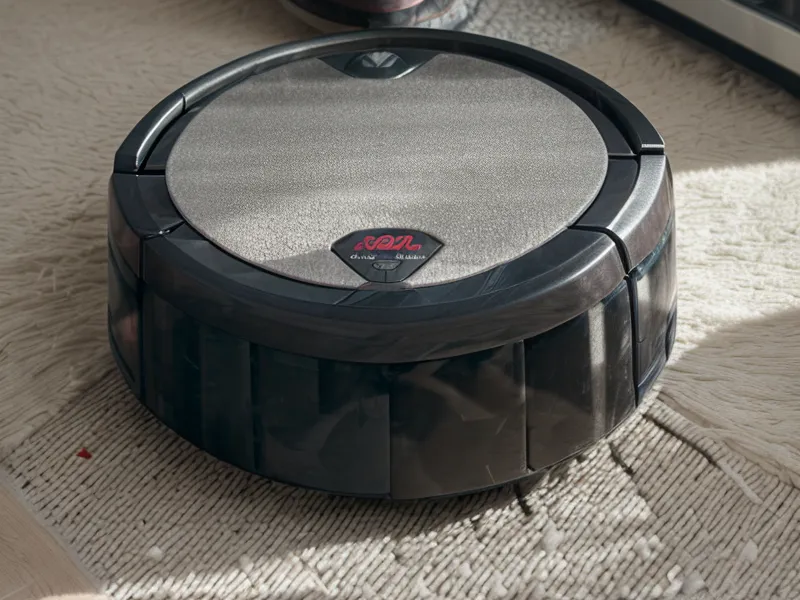
This second fix leaves the sensors untouched and instead draws a virtual boundary around the rug border inside the companion app, so the bot treats it like a wall rather than a cliff. The upside is obvious: the stair sensors stay fully functional everywhere else in the house. The downside is the app itself, which buries manual zone-drawing three menus deep behind a stack of 'smart suggestions' it wants you to accept first — the same kind of friction as a checkout page that keeps surfacing a bundle you didn't ask for before it'll let you just pay. Get the zone boundary wrong by even a little and the bot either still catches the edge or quietly starts skipping a strip of clean floor you actually wanted covered.
A reader named Fabiola Tobin emailed after a long-term review ran, asking whether a replacement she was eyeing would actually behave differently in her house. Her place is carpet wall-to-wall, no hardwood, no dark-bordered rugs breaking up the floor plan, and she's never once described the panicked-spinning behavior that shows up at that one border in mine — which lines up with the idea that the trigger is contrast at an edge, not the rug material itself. It's the kind of outside data point that's more convincing than anything I could reproduce alone with one dog-haired floor plan.
So Which Fix Should You Actually Run?
Cover the sensors with paper or foil when the bot's whole territory is a single level with no real step-down anywhere it travels — garden apartments, ranch houses, any layout where a staircase simply isn't in play. Map a no-go zone in the app instead when there's a basement door, a sunken living room, or anything resembling an actual drop somewhere else on the route, even if the app makes you fight for it. We run the second option here, mostly because of that one afternoon with the basement door standing open, and by the time the dustbin lid lets go of that little metallic click at the end of a run, I'd rather it be from a bot that skipped nothing than one that cleaned the rug border by accident.
If the bot is catching on the rug for a completely different reason — physical snagging on the fringe rather than a sensor ghost — that's a mechanical problem, not an optical one; see why your robot vacuum keeps choking on your area rugs for that side of it. Sam still asks, every few months, why we don't just go back to a regular upright. "Because then I'd have to push it myself," I tell him, and that's usually the end of the debate until the bot finds some new reason to panic at the edge of the rug.